

Hollywood Is Cannibalizing Itself — And Calling It Strategy -
Updated: Apr 21
How fear, franchises, and ‘safe bets’ are draining the life out of cinema—and why audiences are finally walking away-
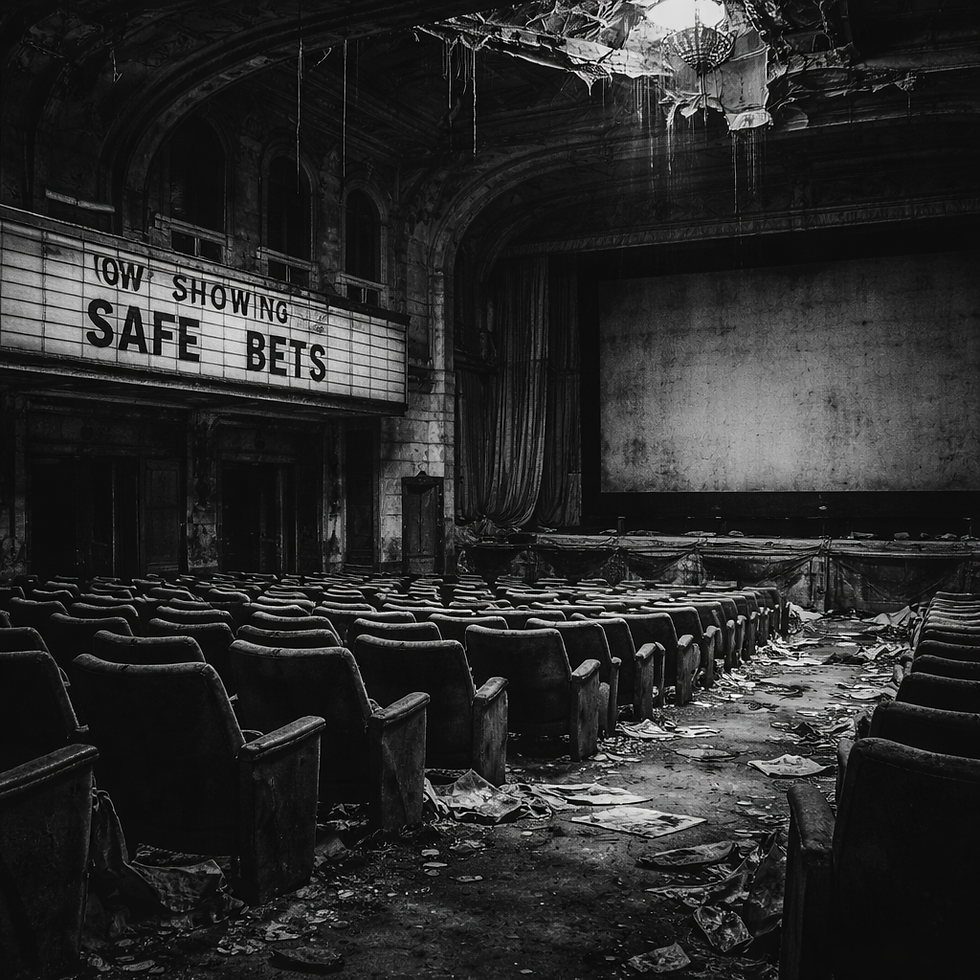
Hollywood Has a Fear Problem Crisis: How Franchise Fatigue Is Killing Original Storytelling
Studios are no longer in the business of storytelling—they’re in the business of risk avoidance.
Instead of backing bold, original ideas, they’ve locked themselves into a cycle of
prequels,
sequels,
reboots,
spin offs,
and nostalgia plays that nobody asked for, but everyone is expected to consume.
The result is a conveyor belt of hollow spectacle—films designed to feel familiar, safe, and marketable, but rarely meaningful.

The "Safe Bet" Illusion in Hollywood
Studios call them “safe bets.”
The logic is simple:
Built-in audiences.
Recognizable brands.
Guaranteed returns.
Except… they’re not working anymore.
These weren’t risks.
They were supposed to be guarantees.
BOX OFFICE LOSSES (SELECTED)
Snow White (Live-Action) — ~$200M+ loss
The Marvels — ~$237M loss
Joker: Folie à Deux — ~$140M+ loss
Indiana Jones and the Dial of Destiny — ~$130M+ loss
Tron: Ares – Estimated loss: ~$132M+

Spielberg's Warning Hollywood Is Cannibalizing Itself — And Calling It Strategy -
When Steven Spielberg speaks about the state of Hollywood—you listen.
Not because it’s opinion.
But because it’s coming from someone who is the architect of modern cinema.
And even he sees the shift.
“The risk-averse nature of the studios today is something I think is a real challenge.”
That fear—of failure, of uncertainty, of anything that isn’t pre-sold—has reshaped the industry.
Studios aren’t chasing great stories anymore. They’re protecting investments.
“There are fewer and fewer films being made today that are original stories.”
Instead, the system is doubling down on what feels familiar—franchises, reboots, extensions of what already worked.
But familiarity isn’t the same as connection.
And audiences feel the difference.
“Franchises are the dominant force, but smaller films are struggling to get seen.”
That imbalance isn’t just creative.
It’s structural.
It leaves less room for risk.
Less room for new voices.
Less room for the kind of stories that once defined cinema.
As those stories disappear, so does something else:
The reason people fell in love with movies in the first place.
“We need to keep the experience of going to the movies alive—and that means giving audiences something they can’t get anywhere else.”
The warning isn’t theoretical.
It’s already happening.

Franchise Fatigue and Audience Burnout
Audiences aren’t confused.
They recognize the pattern.
and rejecting repetition.
The same characters.
The same arcs.
The same emotional beats—repackaged and resold.
What once felt like anticipation now feels predictable.
At the same time, audiences have more choices than ever.
Streaming platforms, global content, and independent films have expanded the landscape beyond the traditional studio system.
If Hollywood won’t offer something fresh—people will find it elsewhere.
And they already are.
And when people stop feeling something in theaters—they don’t argue.
They leave.

When Story Becomes Secondary
The issue isn’t just repetition.
It’s substitution.
Story is no longer the foundation—it’s becoming secondary to positioning.
Films are shaped around market strategy instead of human truth.
But audiences don’t connect to strategy.
They connect to characters. To truth. To something that feels real.
And when that disappears—so does the connection.

The Budget Trap No One Talks About
There’s a fundamental flaw at the center of the modern studio model:
The bigger the budget—the smaller the risk tolerance.
At $200–300 million, every decision becomes cautious.
Stories are simplified.
Edges are smoothed.
Risk is eliminated.
Because failure at that scale isn’t survivable-but neither is originality.
That’s why so many of these films feel interchangeable—technically impressive, financially massive, and creatively forgettable.

The Rise of the Corporate Movie
This is where the model leads.
Not just franchise films—but films built entirely from brand recognition.
Toys.
Apps.
Products.
At that point, the movie isn’t the product.
The brand is.
And audiences can feel the difference.

What We’re Losing
When studios move away from original storytelling, the loss isn’t just creative—it’s cultural.
We lose stories that challenge us.
Stories that provoke conversation.
Stories that stay with us long after the credits roll.
Films like Taxi Driver, Fight Club, and The Truman Show weren’t built on existing IP.
They were built on ideas—bold, uncomfortable, human ideas.
That kind of storytelling hasn’t disappeared.
It’s just no longer the priority.

The Way Forward Isn’t Bigger—It’s Braver
The solution isn’t complicated—it’s just uncomfortable.
Shift the model.
Invest in original stories with controlled budgets.
Take calculated risks instead of inflated ones.
Empower filmmakers instead of IP managers.
Because right now, the industry is spending more—and saying less.

When Story Beats Scale
The proof is already there.
Recent years have shown that smaller, original films can break through in ways that massive productions often can’t.
Anora — made for around $6 million — proved that a film without franchise backing can still cut through culturally and critically.
Everything Everywhere All at Once — made for roughly $25 million — took creative risks that no major franchise would allow, and went on to dominate the Academy Awards.
Get Out — made for about $4.5 million — didn’t just succeed commercially, it reshaped the cultural conversation around genre and storytelling.
None of these films relied on existing IP.
They relied on something far more powerful:
A clear voice.
A bold vision.
A story worth telling.

The Real Equation
When the budget goes down—the creative freedom goes up.
And when creative freedom goes up—the story gets stronger.
Because great films aren’t engineered.
They’re felt.
A $2 million original film that connects with audiences is infinitely more valuable than a $250 million franchise film that disappears a week after release.
Because one builds culture.
The other just fills a release date.

A Different Model
Hollywood doesn’t need more content.
It needs courage.
New voices.
New risks.
New stories.
And if the traditional system isn’t willing to create space for that—
Then that space will be built elsewhere.
Thematic Shift exists to do exactly that.
Not to chase trends.
Not to recycle what’s already been done. But to invest in original storytelling that reflects real human experience.
Because audiences aren’t done with cinema.
They’re done with being underestimated.
And the future of film won’t be defined by what feels safe—
It will be defined by what feels real. Hollywood Is Cannibalizing Itself — And Calling It Strategy -
Hollywood’s Creative Crisis: How Franchise Fatigue Is Killing Original Storytelling
Hollywood creative crisis


Comments